Intro
Introducing a new learning management system can look like immediate saving costs like lower administrative costs and cutting down on employee turnover, time spent on onboarding and more. However, the LMS ROI comes down to how your business and its bottom line are affected by your training programs. You can realize measurable eLearning ROI and cost savings by including an LMS in your training program. This article will explore how to calculate LMS ROI easily with examples so you can do it yourself.
What is ROI in eLearning?
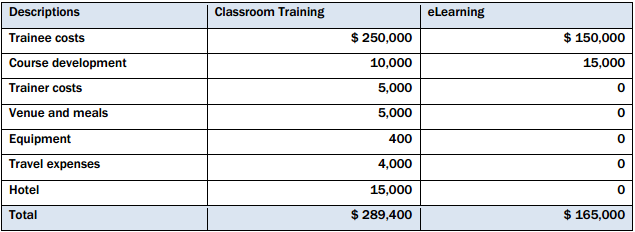
Return on eLearning is a financial calculation used to assess the monetary benefits of online training programs. The eLearning Return of investment calculator compares the cost of producing and delivering training to the value or benefits gained, thereby providing a financial justification for the investment.
Related: Google Whisper Courses Blog
How are ROI cases Calculated?
Return on learning is a global measure of profitability utilized by millions of organizations worldwide as it is straightforward to calculate ROI and understand. Training ROI is calculated by subtracting the original investment value from the end investment value.
ROI is a standardized, global measure of profitability used by millions of companies worldwide because it is relatively simple to calculate and understandable. Furthermore, as the ROI on investment can be either positive or negative, the ROI calculation incorporates the net Return in the numerator. Therefore, when ROI calculations provide a positive outcome, it shows that net returns are positive since total returns surpass total expenses.
Also, When ROI calculations return a negative value, it indicates that net returns are negative because total expenses exceed total returns, implying that this investment results in a loss. Moreover, the full returns and costs should be incorporated to compute ROI with the most incredible precision.
How Do You Measure ROI in Learning and Development?
The Return on investment (ROI) in learning is the same as the traditional one. However, it aims to calculate the benefit the individuals get as the net Return. Let’s check out the simple steps to measure the ROI in learning and development.
Also Read: LMS ROI to Increase Productivity in Business – Paradiso LMS
What is ROI in LMS?
LMS ROI stands for Return on investment for a learning management system. How your training affects your business and its bottom line determines it. Therefore, return on learning is crucial to developing a business case demonstrating how your LMS investment generates revenues and is cost-effective for your organization. But how do you determine and calculate ROI? By using the ROI calculator, one can calculate the ROI.
What is ROI in instructional Design (ID)
Return replaces the ROI in instructional design on expectation (ROE); Donald Kirkpatrick presented the concept in 1959; the ROE is a method in which learning professionals ask questions to improve and explain the expectations of key business stakeholders so that they are satisfied while realistically attaining results in training. Moreover, it is about transforming frequently ambiguous expectations into observable, quantifiable growth results that the entire company appreciates and values.
What is a Good ROI percentage for training?
Several compelling ROI studies demonstrate the valuation of training and development is rising. Training and development ROI percentages have been calculated to range between 4 and 353 per cent. This is a satisfying percentage to discover after comparing before and after measurements and conducting the assessment. However, ensure the numbers in the formula are correct and up to date so that the final number is not misleading.
Is ROI a KPI?
To be obvious, ROI is not a KPI; both words are utilized in different contexts. KPI stands for key performance indicators that help marketers measure their initiative’s short-term impact. Still, they are unlikely to reveal the entire story of a campaign’s worth. ROI, on the other hand, considers the broad picture. It informs you of the overall impact of your campaign or training after concluding the amount of money you invested.
We can conclude that Return on investment is a long-term game, and while KPIs are important for assessing short-term success and maximizing continuing decisions, they should not be confused with ROI. This is because ROI tells the whole story, whereas KPIs reveal what the chapters represent.
Final Thoughts
There’s revenue attached to all the things mentioned on the list. All of the items on the list have revenue attached to them. Either revenue that’s being lost that could be saved or revenue that’s not being tapped into yet that could help your organization grow. The ultimate guide on LMS ROI can help to keep on unwanted expenses. Do you want an ROI for learning management to plan for your educational institutions? Get in Touch Now!